
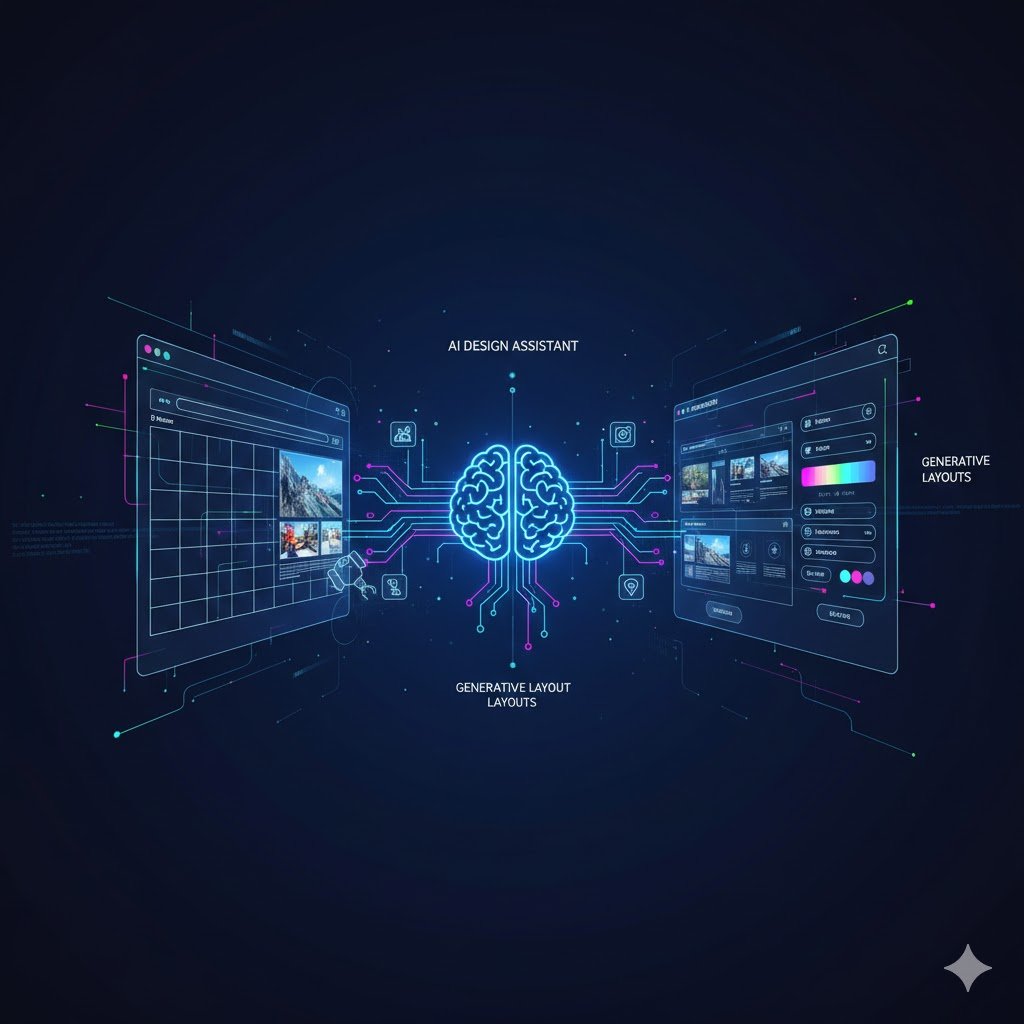
The world of web design is constantly evolving, and the latest catalyst for change is undoubtedly Artificial Intelligence. Far from replacing human creativity, AI is emerging as a powerful co-pilot, empowering designers to streamline workflows, personalize experiences, and bring visionary concepts to life with unprecedented efficiency.
As someone who navigates both language learning with AI (like Aappo!) and the practicalities of business development, I’ve seen firsthand how intelligent tools can transform complex tasks. Web design is no different. Let’s explore how AI is fundamentally reshaping how we build the digital world.
1. Generative Layouts: From Concept to Wireframe in Minutes
One of the most exciting applications of AI in web design is its ability to generate layouts and wireframes. Imagine providing an AI with your project requirements – target audience, brand colors, desired functionalities – and instantly receiving multiple design options.
(Refer to the left side of the image with “Generative Layouts” and grid structures)
This isn’t just about saving time on repetitive tasks; it’s about breaking through creative blocks. AI can offer novel structural ideas that a human designer might not immediately consider, providing a diverse starting point for further refinement. It allows designers to spend less time on basic scaffolding and more time on high-level strategic and creative thinking.
2. Intelligent Design Assistants: Your AI Co-Pilot
Beyond generating full layouts, AI acts as an invaluable design assistant, handling numerous intricate details. These tools can analyze user data to suggest optimal button placements, font pairings, and color palettes that resonate with your audience.
(Refer to the central “AI Design Assistant” brain with glowing circuits connecting elements)
Think about the sheer volume of choices involved in a single web page. An AI assistant can:
-
Optimize UI Elements: Recommend sizes and positions for interactive elements to improve user experience.
-
Ensure Consistency: Maintain brand guidelines across hundreds of pages, ensuring a cohesive look and feel.
-
Automate A/B Testing: Quickly test different design variations to see which performs best, taking the guesswork out of optimization.
3. Personalized User Experiences: The Dynamic Web
Perhaps the most impactful application of AI is in creating truly personalized user experiences. AI can analyze individual user behavior, preferences, and demographics to dynamically adapt website content, layout, and even calls-to-action in real-time.
(Refer to the right side of the image with “Generative Layouts” on a design panel, showing colors and interactive elements)
For businesses, this means:
-
Higher Conversion Rates: Presenting users with exactly what they’re looking for, tailored to their journey.
-
Increased Engagement: Keeping users on your site longer with relevant and appealing content.
-
Smarter E-commerce: AI can power recommendation engines that suggest products based on browsing history, leading to more sales.
The Human Touch Remains Paramount
It’s crucial to remember that AI is a tool, not a replacement for human creativity, empathy, and strategic insight. The best web designs will always be a collaboration between an intelligent machine and a visionary human. AI handles the heavy lifting, the data analysis, and the rapid prototyping, while designers bring the unique vision, cultural understanding, and emotional resonance that only a human can provide.
As we move forward, mastering AI tools in web design will become an essential skill, allowing us to build more intuitive, efficient, and breathtaking digital experiences than ever before.